A Windows workbench for NFC/RFID, LF transponders, automotive immobilisers
and secure smartcard chips — from the card on the reader to a verified crypto kernel.
Nothing painted on: every engine runs against known test vectors. And yes — in a pinch
it resets your toothbrush.
Version 3.98 “Empire Edition"As of 2026-09-14Author Robert SchilkeScope Authorized · public-source
68 / 68crypto self-tests green
4own GPU kernels
95+modules
20+calculators
17smartcard-MCU profiles
~14ksamples · 0 failures
At a glance
Cockpit & self-test
Live Card Lab
Secure smartcard MCU
PulsPirat signal analysis
Local cracking (GPU)
Integrated CVEs
Keyfob Studio
Transponder catalog
Transponder editor
Immobiliser & calculators
Smart clone to T5577
SSR-Labs.de
info@ssr-labs.de
Authorized testing only
SSR-Labs Feature Handout01 · Cockpit
01 Main window
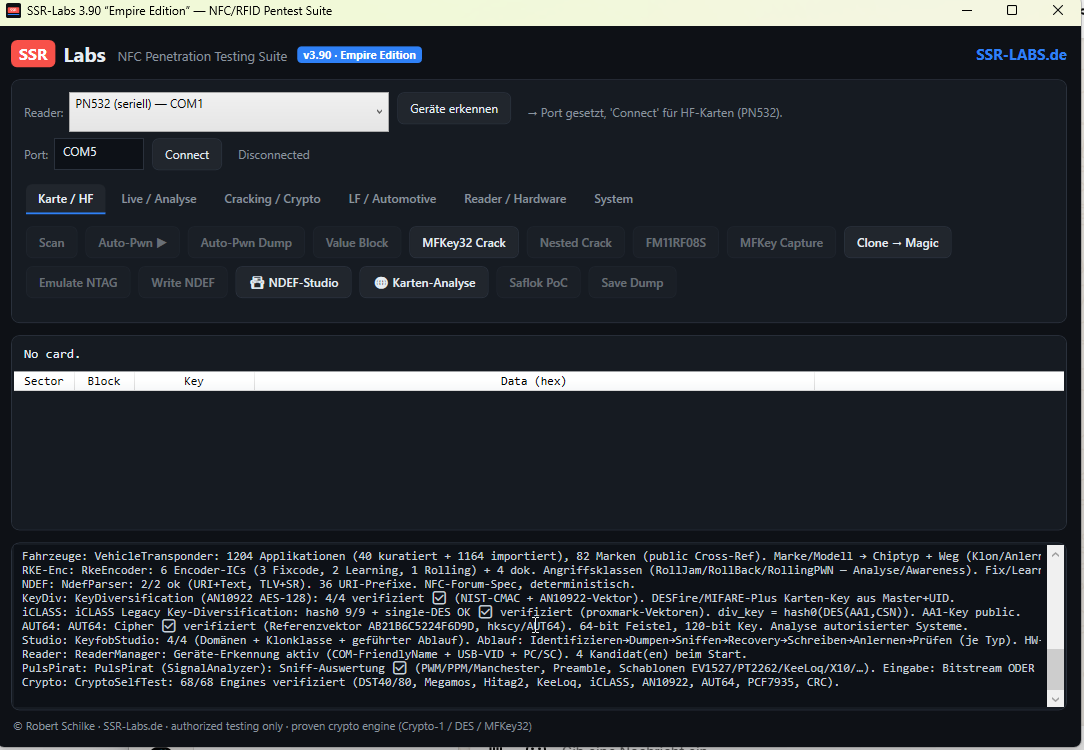
A cockpit that proves itself
On startup the crypto self-test runs — every cipher and recovery engine
against known test vectors. Green means verified, not claimed.
Home screen. Live self-test log, reader selection (PN532 · Proxmark3 · FR-RATEL) and the module launcher.
What happens here
One click on Connect identifies the attached reader by USB VID/PID
and loads exactly its capability profile. From here you open every tool.
The self-test is the suite's honesty anchor: 68 of 68 engines green,
~14,000 samples with zero failures.
Key points
Reader profiles instead of “one driver for all"
Self-test against golden KATs at startup
GPL-free: Crypto-1 recovery from own code
Runs fully offline — no cloud required
SSR-Labs Feature Handout02 · Live Card Lab
02 HF / NFC on the reader
Place a card, see its structure
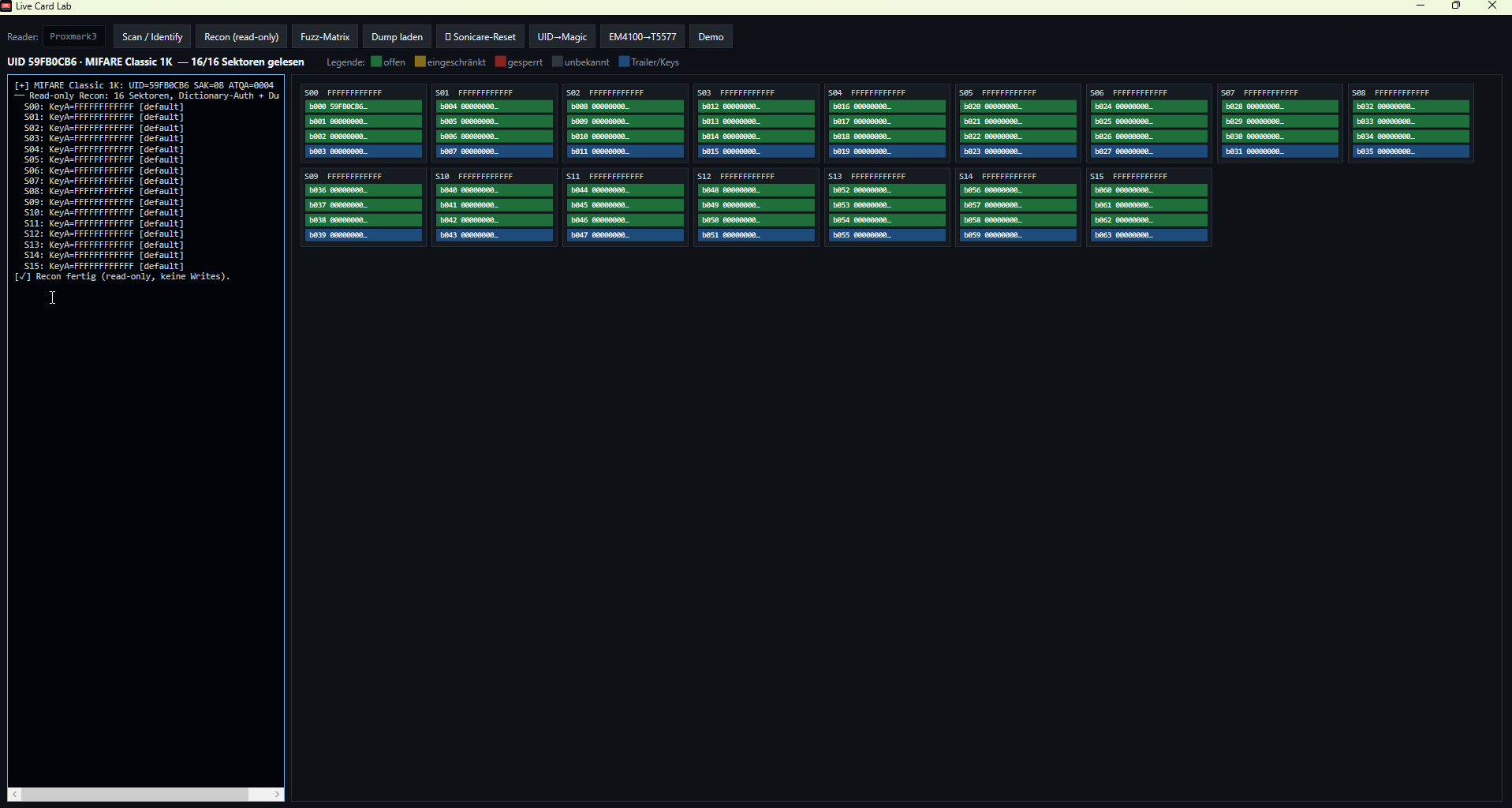
Scan, crack sectors, dump — and get the result as a colored sector map.
Green = key found & read, so you instantly see where a card “opens up".
MIFARE Classic 1K (UID 59FB0CB6) via Proxmark3 — 16 sectors with key-A/key-B status, ready to hand straight to the hex editor.
What it does
Auto-Pwn cracks Crypto-1 (nested / darkside / Fudan RF08S); the dump lands
directly in the tool — hex editor, save and clone all use it immediately.
DESFire & NTAG are detected and read the right way: NTAG recon decodes
NDEF, DESFire shows type, storage, app count and PICC key.
Chips
MIFARE Classic 1K/4K — Crypto-1 recovery
MIFARE Ultralight / NTAG — recon + NDEF
DESFire EV1/2/3 — hf mfdes info
Magic gen1a / gen2 (CUID) — clone target
Proxmark3PN532FR-RATEL
SSR-Labs Feature Handout03 · Secure MCU
03 Pay-TV · Irdeto · Nagra
Looking up secure smartcard MCUs
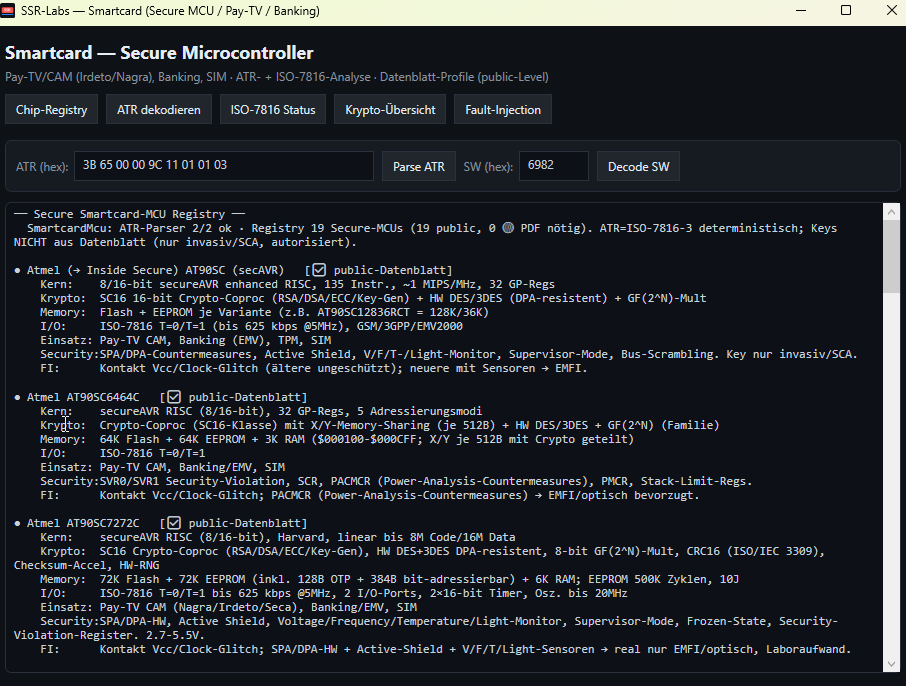
A pure knowledge & reference module: an ATR parser plus a registry
of secure microcontrollers — from Atmel AT90SC through ST19 to NXP SmartMX. Know the chip
and you know its crypto axis. No attack, no emulation — identification only.
Smartcard-MCU registry. ATR breakdown, chip family, crypto co-processor and documented capabilities — every line backed by a public datasheet. To understand, not to break.
What for
During authorized reversing the ATR tells you which security MCU sits in the card —
including its crypto co-processor and publicly documented properties.
It is deliberately purely informational: the module reads, classifies and cites —
it emulates nothing and attacks nothing.
Listed
Atmel AT90SC · secureAVR
ST ST19 / ST23 / ST31 / ST33
NXP P5 SmartMX · P8 · SmartMX2
Infineon SLE66/70/78 · Emosyn TT80
SSR-Labs Feature Handout04 · PulsPirat
04 Signal & protocol
Make raw signals visible
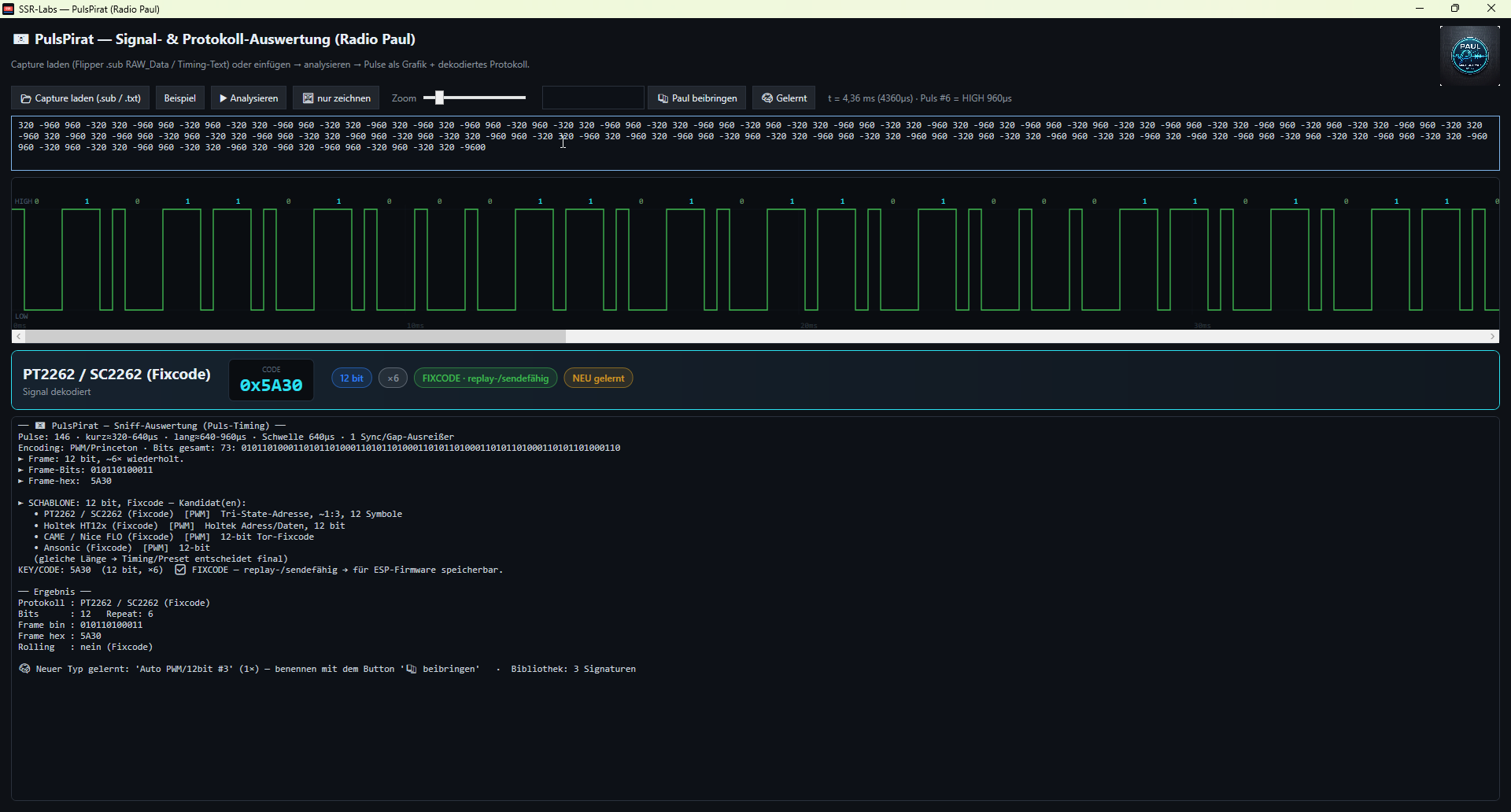
The PulsPirat breaks recorded radio bursts into waveform and bitstream —
PT2262 & friends with decoded address and data word, right on the diagram.
Signal analysis. A PT2262 frame (0x5A30) as a timing waveform — sync, pulse widths and tri-state decode at a glance.
What it does
Recorded pulses are matched against common OOK/ASK encoders; the tool proposes
protocol, clock width and data word — handy for remotes, RF sockets and simple RKE frames.
Detects e.g.
PT2262 / EV1527 tri-state & learning
Manchester & biphase decode
Pulse-width statistics & sync detection
Export of the decoded bits
SSR-Labs Feature Handout05 · Local cracking
05 GPU recovery
Key recovery from sniffed data
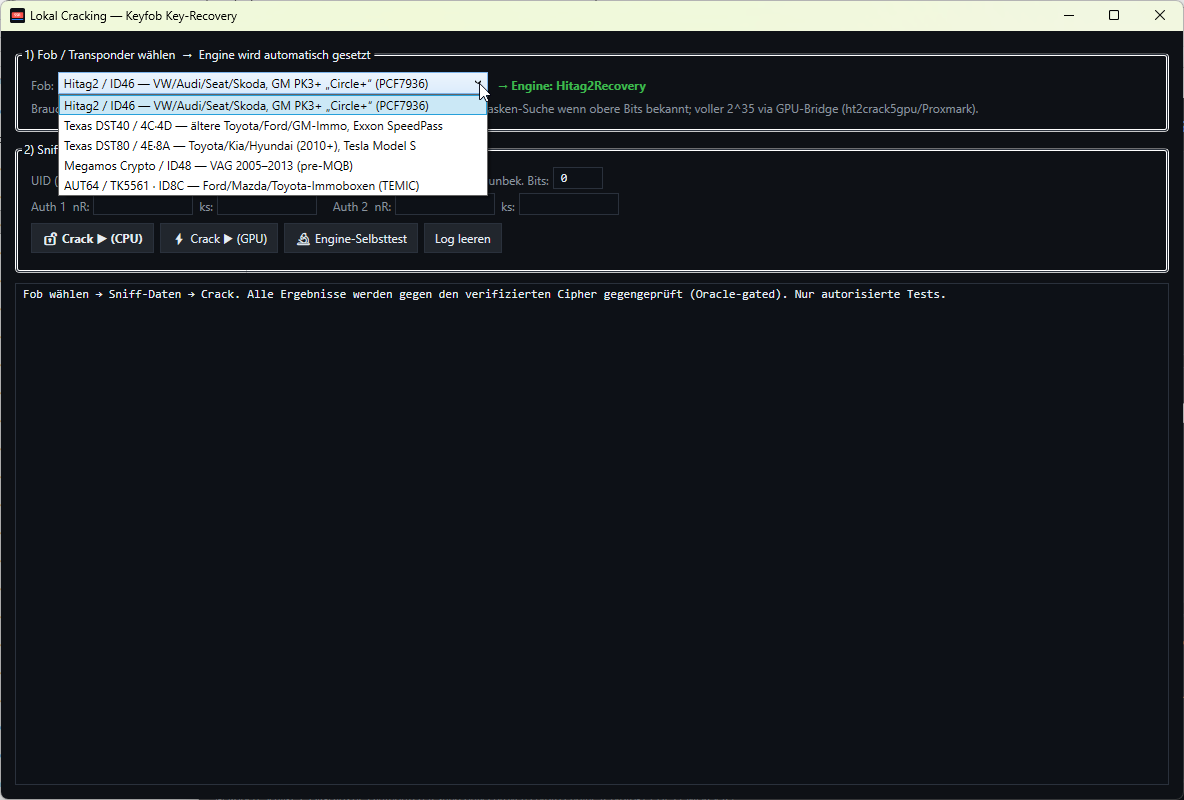
Five automotive ciphers, each with its own engine and — where needed — its
own OpenCL kernel. No CUDA toolkit, no third-party headers, results checked against KAT.
Local cracking. Engine choice Hitag2 · DST40 · DST80 · Megamos · AUT64 — sniffed auths in, key out.
Engines
Hitag2 / ID46 — 2 auths → key; full 2³⁵ on GPU (~1.1 bn/s)
DST40 — 2⁴⁰ GPU brute (~135 M/s)
DST80 — full 80 bit via keyL/keyR downgrade
Megamos ID48 — em4x70 partial → 96-bit key
AUT64 / TK5561 — kG-from-IDCode + pbox recover
Principle
The reader is only a nonce oracle — the actual recovery runs in the native PC
engine. GPU results are always oracle-gated: recovered keys are checked against
real data, never guessed.
RTX-verifiedzero-dependency
SSR-Labs Feature Handout06 · CVEs
06 Public vulnerabilities
Integrated, documented CVEs
No hand-waving — the suite runs known, publicly documented NFC weaknesses
as reproducible PoCs, each with a source reference.
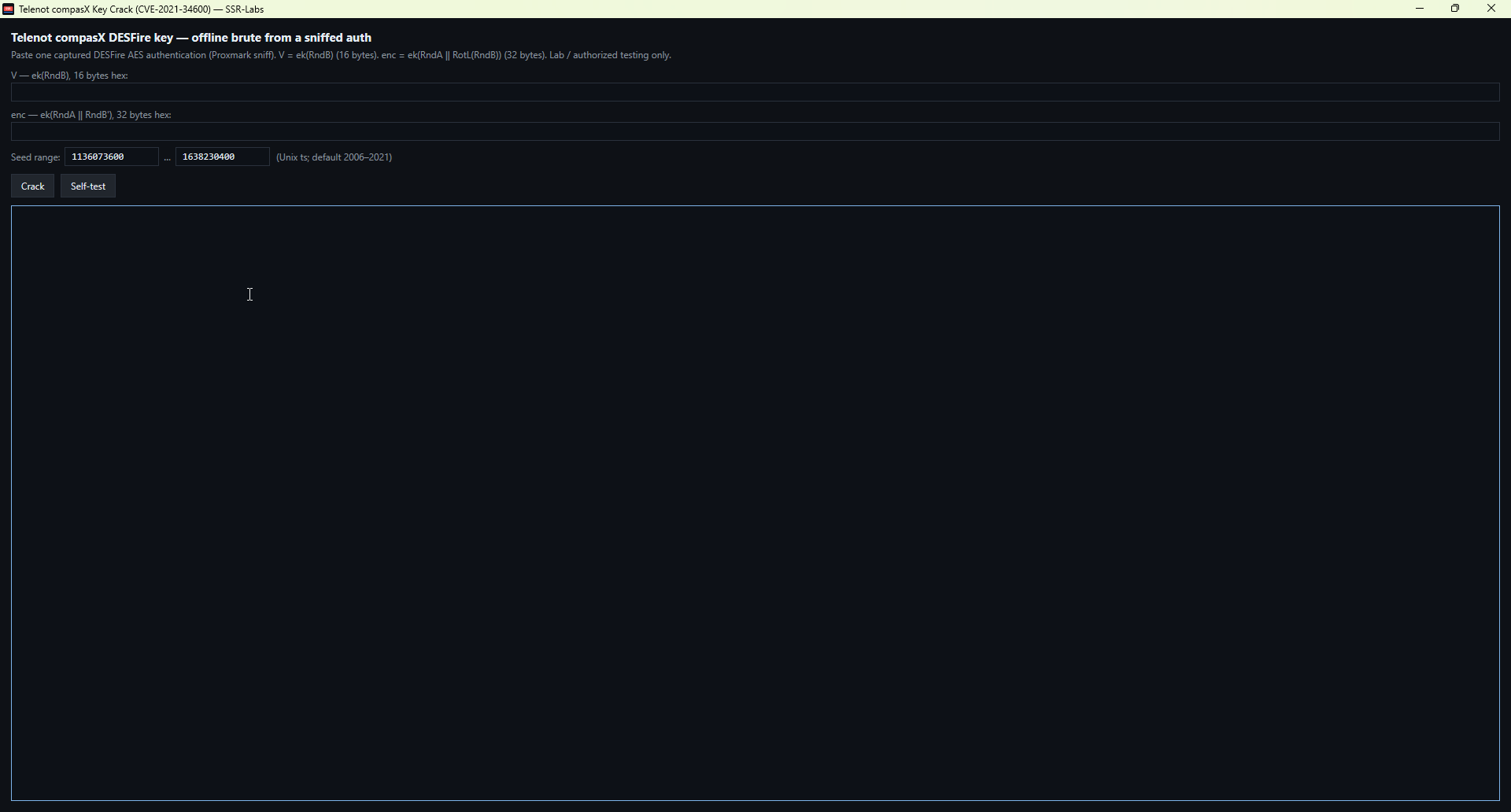
Telenot compasX (CVE-2021-34600). Publicly documented DESFire key derivation from the UID — as a verifiable PoC inside the tool.
Included
Telenot compasX — DESFire key from UID CVE-2021-34600
KioSoft laundry systems
Fudan FM11RF08S — static-nested backdoor key
Be-Tech & Saflok — public-KDF PoC (owned HW)
Stance
Reading and analysing cards is legitimate dual use. What the tool deliberately
does not build: turnkey forgery buttons. PoCs run on owned hardware, from
public/open-source material — no leaked keys.
SSR-Labs Feature Handout07 · Keyfob Studio
07 LF transponders
Keyfobs: identify → read → recover
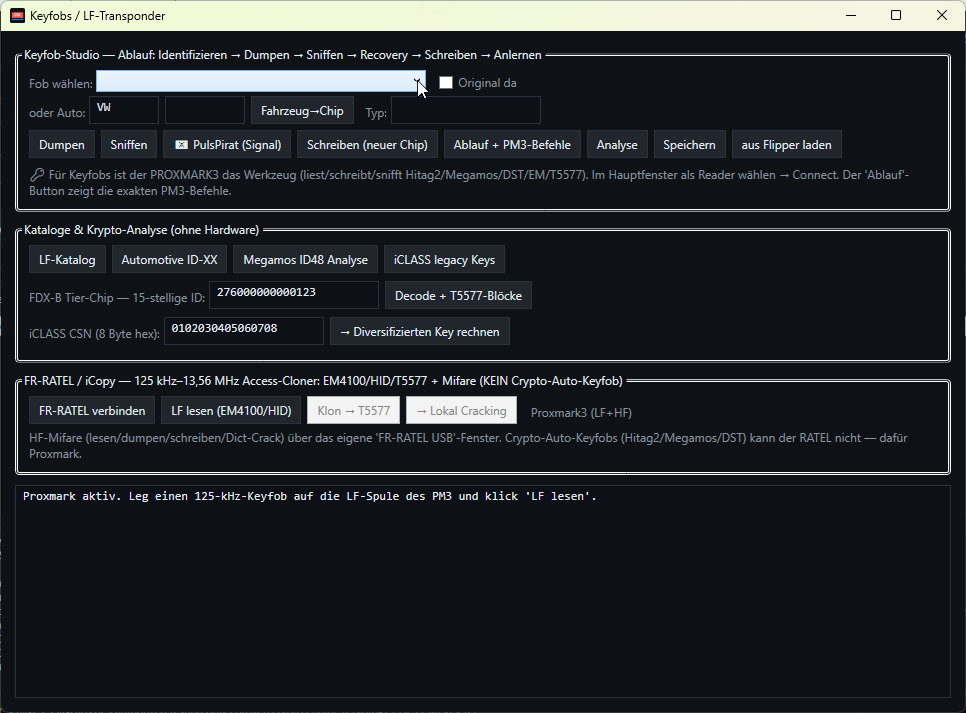
A guided flow — identify → dump → sniff → recovery.
The Proxmark reads; the tool shows the exact PM3 commands.
Keyfob Studio. Pick a fob or resolve it via Vehicle→Chip; FDX-B pet-chip and iCLASS-CSN calculators included.
Two paths
PROXMARK3 for crypto fobs (Hitag2/Megamos/DST) — reads & sniffs
and shows the PM3 commands; the data feeds key recovery. No
writing/cloning of these fobs (honestly: not testable without a real fob).
FR-RATEL / iCopy as a 125-kHz/13.56-MHz cloner for EM4100/HID/T5577 + Mifare —
honestly labelled: no crypto auto-keyfob.
Helper calculators
FDX-B pet chip → T5577 blocks
iCLASS CSN → diversified key
Automotive ID-XX & Megamos-ID48 analysis
Read data optionally → cracker
SSR-Labs Feature Handout08 · Catalog
08 Transponder knowledge
The transponder catalog
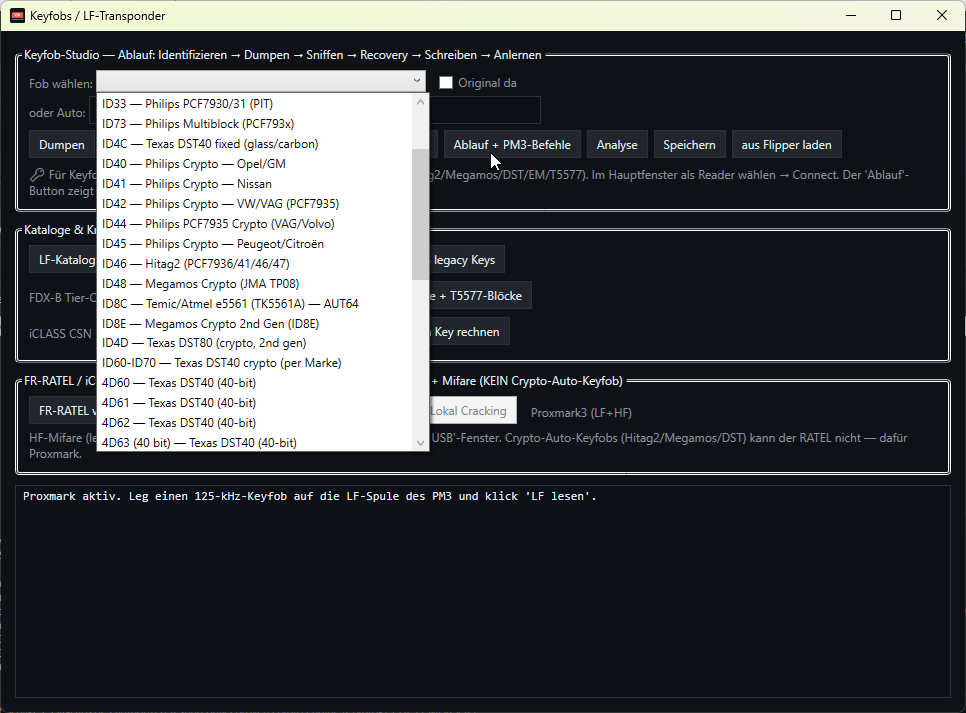
~1,200 vehicle→chip mappings and the full LF family table —
from Philips PCF through Texas DST40/80 to Megamos and Hitag2.
ID catalog. ID33–ID8E & the 4D series with plain-text mapping (maker, cipher, typical brand) — so you don't have to google the chip mid-job.
What's inside
Every transponder ID with chip type, crypto class and vehicle context —
e.g. ID48 = Megamos Crypto, ID46 = Hitag2, ID4D = Texas DST80.
Plus catalogs for transit worldwide (29 systems), access-control systems and
Chinese chip makers — all searchable.
Examples
ID46 Hitag2 (PCF7936/41/46/47)
ID48 Megamos Crypto (JMA TP08)
ID4D Texas DST80 (crypto, 2nd gen)
ID8C Temic/Atmel e5561 — AUT64
SSR-Labs Feature Handout09 · Editor
09 Crypto workbench
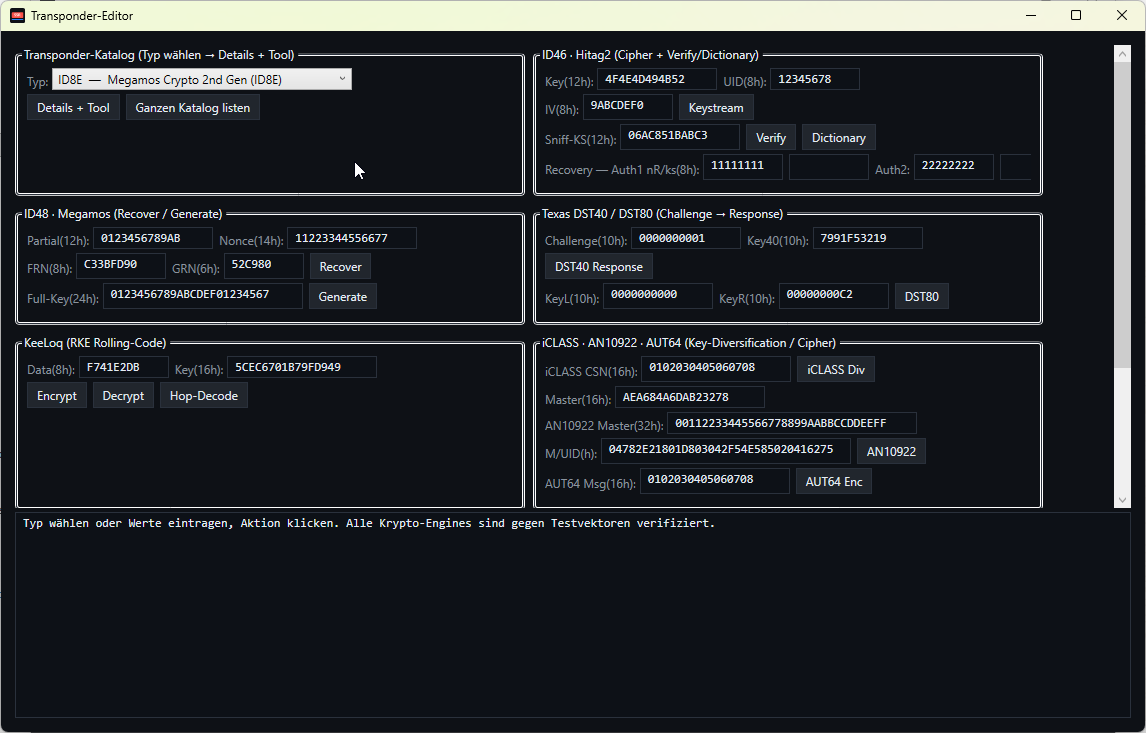
Transponder editor: real ciphers
Enter values, click an action — every crypto engine verified against test vectors.
Not an info sheet, but ciphers that actually compute.
Transponder editor. Hitag2 keystream/verify/dictionary, Megamos recover/generate, DST40/DST80 response, KeeLoq hop-decode and iCLASS/AN10922 diversification — in one window.
This surface makes the suite verifiable: anyone can feed their own test vectors
and check the result against the literature. That is exactly what separates real
reversing from marketing.
SSR-Labs Feature Handout10 · Immobiliser
10 Automotive
Immobiliser & calculators
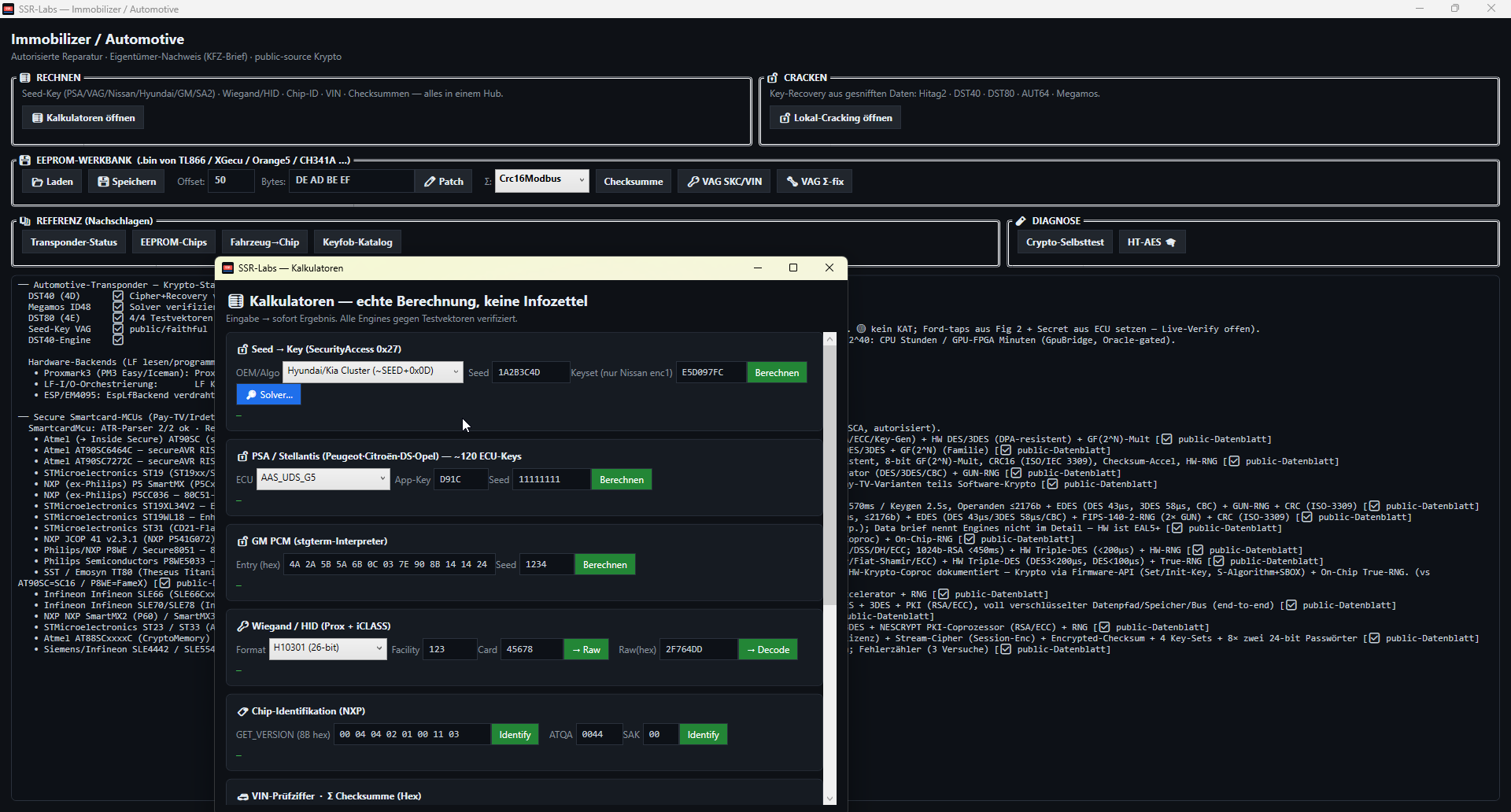
Authorized repair & proof of ownership: seed-key, EEPROM bench,
Wiegand/HID, chip ID, VIN — all in one hub, all computing.
Immobiliser hub + calculators. Seed→Key for Hyundai/Kia, PSA/Stellantis (~120 ECUs), GM PCM, plus Wiegand/HID and NXP chip identification.
Reference lookups (transponder status, EEPROM chips, vehicle→chip) and the crypto
self-test right beside it. OBD/ELM327 (VIN decode, fault codes, UDS
SecurityAccess) is built but 🟡 work in progress — not yet verified against
a real dongle/vehicle.
public-source cryptoauthorized
SSR-Labs Feature Handout11 · Smart clone
11 LF cloning
Smart cloning to T5577
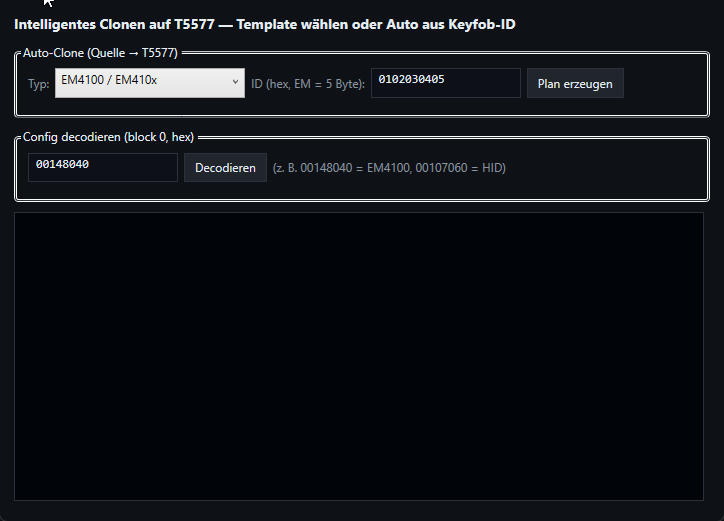
Read source → write target, with the path in view. Pick a template or auto
from the keyfob ID — config decoder included.
Smart clone. Plan EM4100/EM410x by ID onto a T5577; decode the block-0 config (00148040 = EM4100, 00107060 = HID).
The flow
The clone flow is deliberately visual: first dump the source, then prompt for a
blank card, then write and verify — with a clear statement of which card or token
type works as the target.
Same principle for UID → Magic and EM4100 → T5577: always source → target.
Targets
T5577 — emulate EM4100/HID
Magic gen1a — cload
Magic gen2 / CUID — restore --force
Config decoder for block-0 checks
SSR-Labs Feature HandoutScope & contact
✚ Collaboration
Scope, honesty & sponsoring
The tool is built for authorized testing, repair and research from
public/open-source material. What is verified is green; what still needs hardware is
honestly marked 🟡 open.
Sponsoring & test hardware
Some engines are only waiting on real hardware for a cross-check — automotive keyfobs
(Hitag2/Megamos/DST), iCLASS/LEGIC cards, Tonie/SLIX, OBD/ECU dumps, ISM transmitters.
Anyone who contributes such hardware is credited by name as a sponsor in the tool
and in this brief.
Money or hardware, from wherever — every contribution turns a 🟡 engine
green.
Contact · info@ssr-labs.de · SSR-Labs.de
P.S. · Department of “because we can"
Yes, the tool resets your toothbrush. Philips Sonicare brush heads carry an
NTAG213C that tells the handle “I'm worn out" — once the usage counter is full, it
throttles. The password is derivable from the UID (CRC16-CCITT), so the suite
computes it, resets the counter, and the 20-euro head lives on.
Same technology, same chip, same thinking as the immobiliser — only this time the attack
vector is called plaque. The very same principle sits behind printer DRM, vacuum
bags and 3D-printer spools: your device, your call.
SSR-Labs · Robert Schilke. NFC/RFID · LF transponders · automotive immobilisers ·
secure smartcard MCU. Version 3.98 “Empire Edition", as of 2026-09-14.
For authorized security testing, repair and education only. Sources: public/open-source
only — no leaked specifications or keys. Full version:
CAPABILITIES.en.html (EN) · CAPABILITIES.html (DE).